
Securing the Remote Workforce: How SASE and Cloud Firewalls Work Together
Working from home or on the go has become the new normal, but it also brings new risks that many businesses aren’t prepared for. When teams connect from different locations, protecting company data gets a lot more complicated. That’s where smarter online protection, like cloud firewalls and SASE, comes in. SASE provides identity-based access controls, while cloud firewalls conduct thorough checks on traffic before it reaches your applications.
Together, they provide users with fast and reliable connections, giving IT teams peace of mind without the headache of managing numerous appliances. Whether you’re running a small business or managing a growing team, understanding how these security tools work together can help you stay one step ahead of cyber threats without adding extra stress.
In this blog, we will explore the growing importance of remote workforce security and how SASE and cloud firewalls collaborate to keep your remote workforce secure, as well as the benefits of a converged approach.
The Rising Importance of Remote Workforce Security
Remote work brings freedom, but also new security challenges. When your team logs in from home or public hotspots, every device and network can be an entry point for cyber threats. There are not a few but many reasons indicating remote workforce security is critical:
- Multiple Access Points: Laptops, tablets, and phones all connect from outside the office.
- Unprotected Networks: Home or public Wi‑Fi often lacks strong firewalls or regular updates.
- Data Interception: Sensitive files, such as customer details and financial reports, can be intercepted in transit.
- Phishing Risks: Remote employees may be more likely to click on fake links when they are outside a secure network.
- Unmanaged Devices: Personal and work devices mix, making it hard to enforce consistent security settings.
- Compliance Gaps: Regulations may require stricter controls on data access and storage, including off-site storage.
- Rapid Scaling: As teams grow or shift, manual security checks can’t keep up.
- Operational Headaches: Managing multiple point solutions increases costs and complexity.
By using a unified approach, where identity checks and traffic filters work together, you can fill these gaps, reduce risk, and keep your remote team productive and protected.
Understanding SASE and Cloud Firewalls
SASE
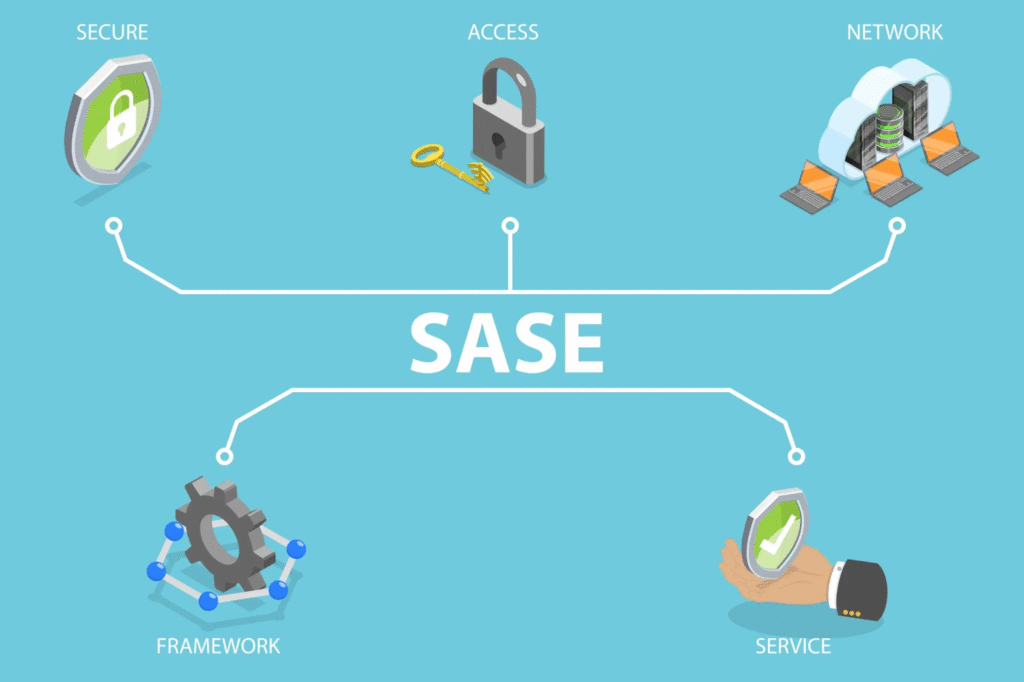
SASE is a cloud service that combines networking and security into a single system. It verifies who you are and checks whether your device is secure before allowing you to connect. By using the nearest cloud hub, SASE ensures your data travels quickly and safely. As threats change, it automatically updates rules so your users always stay protected without slowing down their work.
Cloud Firewalls
Cloud firewalls live in the cloud and inspect all traffic before it reaches your applications. They look for harmful activity and enforce the same security rules everywhere your team connects. Because they run in the cloud, you don’t need to manage physical equipment or worry about capacity limits. As your remote workforce grows, cloud firewalls scale with your needs, keeping operations running smoothly.
Why Integrate SASE and Cloud Firewalls?
Integrating SASE and cloud firewalls gives your business a stronger, simpler security setup for remote teams. By combining identity-based access controls with deep traffic inspection, you achieve consistent protection regardless of where your employees connect from. Here’s why bringing these technologies together makes sense:
- Unified Defense: SASE verifies users and devices, while cloud firewalls scan every packet, so there are no gaps between identity checks and threat blocking.
- Better Performance: Traffic is routed through nearby cloud hubs for fast connections, and security checks happen in the same place, reducing delays.
- Easier Management: Instead of juggling separate tools, you use one dashboard to set policies, monitor threats, and update rules automatically.
- Scalable Protection: As your team grows or shifts locations, cloud‑based services expand on demand, with no need for new hardware or manual configuration.
- Cost Efficiency: A single subscription replaces multiple point solutions, reducing capital expenses and lowering ongoing maintenance costs.
Together, SASE and cloud firewalls ensure your remote workforce security stays tight, simple, and ready for whatever comes next.
How SASE and Cloud Firewalls Integrate to Secure Remote Workforces
- Real‑Time Threat Intelligence
By integrating SASE with cloud firewalls, businesses gain an always‑on stream of threat data across every connection. When one user encounters a new malware signature or a suspicious IP address, that insight is instantly shared throughout the network.
The cloud firewall uses these updates to block malicious packets before they reach applications, while SASE pushes refreshed rules to every device. This automated approach keeps remote teams safe without manual patches or delays. Even if an attack begins on a single endpoint, defenses adapt within seconds, shrinking the window for damage and ensuring uninterrupted work.
- Data Loss Prevention
Linking SASE and cloud firewalls means inspecting data as it moves in and out of the network to stop leaks. Sensitive files exhibit identifiable patterns that DLP tools can detect in real-time. If a remote employee tries to upload or share protected documents, the system scans content, flags confidential information, and either encrypts or blocks the transfer.
Everything happens in the cloud, so users aren’t interrupted and IT teams don’t need to configure dozens of local rules. Your critical data remains secure, whether staff work from home or on the go.
- Centralized Management
Handling separate VPNs, firewalls, and security consoles can overwhelm IT staff. When SASE and cloud firewalls merge into a single platform, policies, updates, and logs are all displayed in a unified dashboard. Adjust access settings, apply new firewall rules, or review alerts without switching tools.
This unified interface reduces errors, accelerates response times, and frees your team to tackle strategic projects instead of routine maintenance. As your remote workforce scales or shifts locations, policy changes roll out instantly across every user and device.
- Comprehensive Visibility
Clear insights into user activity and data flows are vital for spotting hidden risks. Paired SASE and cloud firewalls track every session, showing who’s connecting, which apps they use, and where information travels. If a device suddenly uploads large volumes of data or connects to unfamiliar servers, alerts are fired immediately.
This real-time monitoring uncovers minor anomalies before they escalate into full-blown breaches. Plus, having complete logs makes compliance reporting and audits far simpler and more reliable.
- Unified Policy Enforcement
When identity checks in SASE and traffic rules in cloud firewalls share the same policy set, conflicts disappear. Create a rule, like blocking social media during work hours, and SASE handles the user verification while the firewall enforces the block.
Employees experience a consistent environment, regardless of how or where they connect. This cohesion closes security gaps that attackers love to exploit, making policy updates straightforward. A single change propagates instantly to all users and devices, maintaining a tight and uniform security posture.
Final Words
Bringing together SASE and cloud firewalls gives your business a single, cloud‑based solution that keeps every remote worker safe, no matter where they connect. By verifying identities, inspecting all traffic, and sharing up-to-the-minute threat data, this approach closes security gaps and simplifies policy management. With unified tools and automatic updates, your team stays protected without extra hardware or complex setups, so you can focus on growing your business with confidence.
