
In the Australian legal landscape, complexity is often a barrier to justice. Whether you are a law student or a practitioner, the sheer density of High Court rulings can feel like a labyrinth of archaic language and layered jurisprudence.
Understanding why the law feels complex is the first step toward mastering the rhetoric needed to simplify it.
Why Australian Law and Case Law Feel Inaccessible

The Australian legal system is unique because it draws from a “triple-threat” of sources:
- Parliamentary Legislation: The formal statutes and acts.
- Judicial Precedents: The evolving body of common law.
- Constitutional Principles: The fundamental framework of the Commonwealth.
When these sources intersect, the result is often “legalese”—long, winding sentences that are difficult to parse without a robust Australian legal case database providing streamlined access to AU, UK, and NZ cases, such as CaseChat AU. In a legal context, rhetoric is the strategic use of language to bridge this gap, allowing you to explain and present these complex ideas clearly.
The 3 Classical Modes of Persuasion
One of the main skills a legal professional should have is the art of persuasion. In writing your court submissions (or even your law school essays), knowing who & what you are writing for varies widely since each requires a different approach.
For example, writing for a court demands formal tone, precise terminology, and strong reliance on precedent. In contrast, explaining the same legal issue to a professor/ a class requires simpler language, clear explanations, and practical implications rather than technical detail.
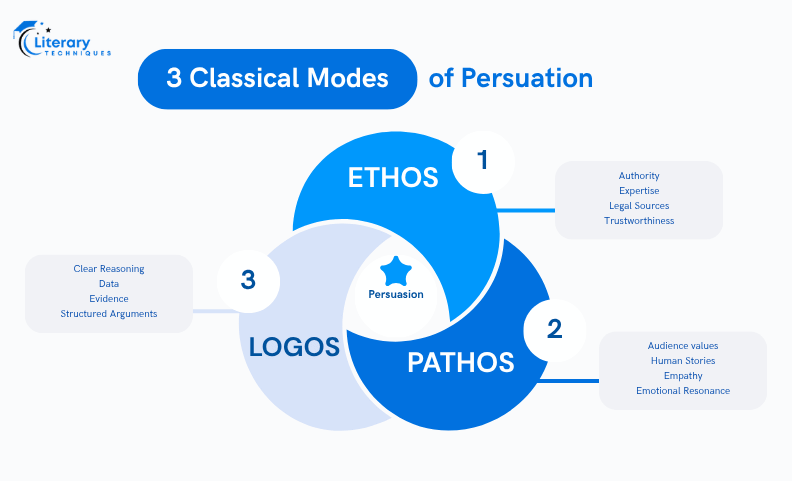
Knowing what tone of writing is useful to your particular purpose is essential to legal writing success. Below are some of the basic modes of persuasive writing:
- Ethos (Credibility): Grounding arguments in legal precedent and legislative rules.
- Pathos (Relatability): Appealing to the human impact of the law to make it persuasive.
- Logos (Logic): Structuring arguments with clear, step-by-step reasoning.
High-Impact Rhetorical Techniques
By using specific techniques, you can distill a 100-page ruling into a punchy, readable case note without losing nuance.
1. Parallelism (Clarity & Balance)
Parallelism in legal writing pertains to the use of consistent linguistic structure to present related ideas in a clear, balanced, and logical manner. For example, below is a side-by-side example of a weak, non-parallel sentence, and a strong, parallel legal phrase:
- Weak: To establish negligence, a plaintiff must show duty, breach of duty, and that harm was caused by the defendant’s actions.
- Improved (parallel): To establish negligence, a plaintiff must show duty, breach, and causation.
Verdict: The second sentence is clearer and an overall smoother read. It is noticeable also that presenting your ideas in a parallel structure allows each point to stand balance & complement the points well
Parallelism is particularly useful when:
- summarising case holdings or legal principles
- listing elements of a legal test
- comparing arguments or contrasting positions
- structuring issue-based analysis (e.g., IRAC)
2. The Power of the Tricolon (Memorability)
A tricolon is a rhetorical device where three parallel words, phrases, or clauses are grouped together to express a single idea. In legal writing, it is used to make arguments more structured, memorable, and persuasive.
The tricolon is effective because it:
- creates rhythm and readability
- helps structure complex legal reasoning
- improves memorability for exams and case notes
- highlights key legal elements without unnecessary detail
Some examples where tricolons can be used are:
- Case analysis summary: The court found the facts persuasive, the statute applicable, and the precedent binding.
- Legal reasoning: The argument failed for lacking evidence, contradicting authority, and misapplying the law.
- Contract law principle: A valid contract requires offer, acceptance, and consideration.
3. Modern Brevity over Archaic Expressions
While “henceforth” and “aforementioned” feel “legal,” they often obscure the ratio decidendi. Replacing archaic expressions with modern English improves scannability—a key metric for both human readers and 2026 search algorithms.
Structuring Arguments for Maximum Impact
Clarity of structure is essential because common law arguments depend on linking facts to principles. For the best results, adopt the IRAC (Issue, Rule, Application, Conclusion) method:
- Issue: Identify the legal question at the very beginning.
- Rule: State the relevant statute or case law clearly before the analysis.
- Application: Apply the law directly to the facts using signposting words (First, Therefore, However).
- Conclusion: Summarize how the application of the rule resolves the issue.
Conclusion
Rhetoric is not just a technique—it is a practical method for making complex legal ideas understandable. In the context of Australian legal writing, where judgments, statutes, and precedents often interact in layered and technical ways, rhetorical techniques help transform dense material into clear, structured communication.
By using strategies such as clarity, structure, audience awareness, parallelism, and the tricolon, law students and practitioners can break down difficult cases into manageable and meaningful parts made ever faster with assistive AI tools.
By using strategies such as clarity, structure, audience awareness, parallelism, and the tricolon, law students and practitioners can break down difficult cases into manageable parts, a process simplified by platforms like CaseChat AU that leverage AI to distill complex High Court rulings into structured summaries.
Final Takeaway: Stop being intimidated by the text and start controlling the narrative. By refining how you write, you improve not only your legal understanding but also the broader access to justice.
