
Work has changed. Over the past several years, remote and hybrid arrangements have shifted from a novelty to the norm for millions of professionals across industries. With that shift came a fundamental question that businesses have been wrestling with ever since: how do you manage people you can not see?
The answer, for a growing number of organizations, has been employee monitoring. What started as simple time-tracking tools has evolved into a sophisticated category of employee monitoring software that touches everything from productivity measurement to cybersecurity. And it is still changing fast.
What Is Employee Monitoring In Remote Work Environments?
Understanding Modern Employee Monitoring
At its core, employee monitoring refers to the practice of tracking how, when, and where employees work. In a remote context, that means digital tools rather than a manager walking the floor. Modern solutions cover a wide spectrum: time tracking that logs when someone clocks in and out, activity monitoring that records which applications and websites are in use, productivity analytics that measure output against benchmarks, and broader workforce intelligence platforms that pull all of this together.
Why Businesses Use Employee Monitoring Software
The motivations are varied. Some companies adopt monitoring tools primarily for security, wanting to detect data leaks or unauthorized access before they become crises. Others focus on productivity, using data to understand where time is being lost and how workflows could be improved. For businesses in regulated industries, monitoring is often tied to compliance requirements. And for managers navigating hybrid teams spread across time zones, it provides a baseline of visibility that physical proximity once provided naturally.
How Remote Work Changed Employee Monitoring
The Rise of Hybrid and Remote Teams
Before remote work became widespread, oversight was largely passive. Managers could observe their teams without any formal system. The transition to distributed work did not just change where people work; it removed that passive visibility entirely. Businesses needed new ways to stay connected to how work was actually happening, and the monitoring software market grew to meet that demand.
From Time Tracking to Outcome-Based Monitoring
One meaningful shift has been the move away from tracking hours toward tracking outcomes. Counting the minutes someone spends logged in says very little about whether they are doing good work. More progressive organizations have moved toward models where performance metrics center on deliverables, project completion rates, and quality of output rather than raw activity data. This change reflects a broader rethinking of what productivity actually means.
Why Traditional Monitoring Methods Are Becoming Outdated
Heavy-handed monitoring, like constant screenshots and keystroke logging, has a cost. Employees who feel surveilled rather than trusted tend to become disengaged. Research consistently shows that micromanagement damages morale and can actually reduce the productivity it is supposed to improve. The tools that are gaining traction today are ones that provide meaningful insight without treating workers like suspects.
The Future Of Employee Monitoring
AI-Powered Employee Monitoring Software
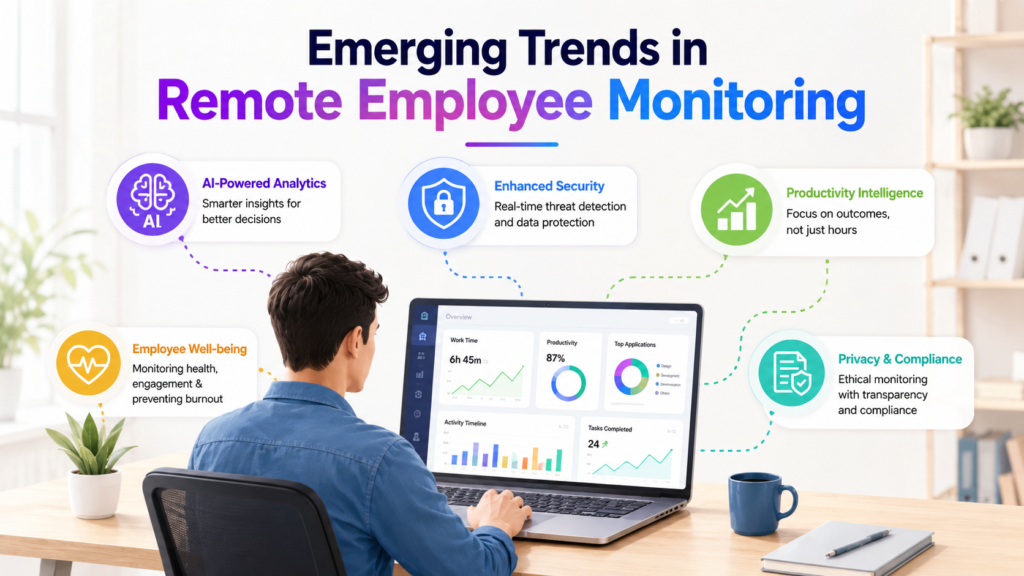
Artificial intelligence is transforming what monitoring software can do. Predictive analytics can flag when a team member appears to be on a path toward burnout before it happens. Smart productivity tracking can distinguish between deep focus work and surface-level activity, giving managers a more honest picture of where effort is going. Automated reporting means that insights surface without requiring someone to dig through raw data.
Behavioral Analytics and Workforce Intelligence
Beyond tracking individuals, AI-powered platforms are increasingly good at understanding teams as a whole. Pattern recognition can identify workflow bottlenecks, reveal which collaboration tools are actually being used, and surface insights about how projects move through an organization. Used well, this kind of workforce intelligence helps leaders make decisions based on data rather than assumptions.
The Growing Importance Of Privacy And Ethical Employee Monitoring
Employee Privacy Concerns in Remote Work
The same tools that give employers visibility can feel deeply invasive to the people being monitored. Screen recording, keystroke logging, and location tracking raise legitimate concerns about where professional oversight ends and personal privacy begins. When monitoring extends to home environments, the line between work and personal life becomes uncomfortably blurred.
Legal Regulations Around Employee Monitoring Software
Regulation in this space is tightening. GDPR requirements in Europe place strict constraints on how employee data can be collected, stored, and used. Many jurisdictions now require that employees be informed about monitoring practices before they begin. In some regions, certain forms of monitoring require explicit consent. Businesses that do not stay current with these rules face real legal exposure.
Best Practices for Ethical Employee Monitoring
The organizations getting this right tend to follow a few consistent principles. They are transparent about what is being tracked and why. They collect only the data that serves a specific, legitimate purpose. They frame monitoring as a tool for support and improvement rather than surveillance. And they invite employees into the conversation about how monitoring policies are designed.
Cybersecurity And Employee Monitoring In Remote Teams
Remote work dramatically expanded the attack surface that businesses have to defend. Employees working from home networks, using personal devices, and accessing cloud systems from multiple locations create security challenges that office-based environments do not have to deal with in the same way. Employee monitoring software has become an important layer of the cybersecurity stack.
Modern platforms can detect unusual access patterns that might indicate a compromised account or an insider threat. They can monitor file transfers to flag potential data exfiltration. AI-driven anomaly detection can identify behavior that deviates from an employee’s normal patterns and trigger alerts before damage is done. For security teams managing distributed workforces, this kind of visibility is not a nice-to-have; it is essential.
The Impact Of Employee Monitoring On Workplace Culture
Does Employee Monitoring Improve Productivity?
The evidence is mixed and heavily dependent on implementation. When monitoring is used to identify inefficiencies and support employees in doing their best work, productivity tends to improve. Accountability structures, even light ones, can help people stay focused. But when monitoring becomes a source of anxiety or is perceived as distrust, the effect reverses.
Building Trust While Using Employee Monitoring Software
The most successful implementations tend to share a common thread: the people being monitored understand what is tracked, why it matters, and how the data will and will not be used. When employees feel like partners in the process rather than subjects of it, monitoring loses much of its sting. Leaders who communicate openly about their approach and demonstrate that monitoring is about helping rather than catching build cultures where oversight and trust coexist.
Emerging Trends In Employee Monitoring Software
Cloud-based monitoring platforms have become the standard, offering scalability and real-time analytics that legacy tools could not match. They integrate with the collaboration tools teams already use, making data collection less intrusive and insights more contextual.
Privacy-focused monitoring tools are gaining ground as a direct response to the backlash against invasive tracking. These platforms are designed around minimal data collection, often giving employees access to their own data and a degree of control over what is shared. The pitch is transparency by design rather than surveillance by default.
Wearable technology is still emerging in workplace contexts, with some industries exploring biometric data for health and fatigue monitoring. The ethical questions here are significant, and wide adoption remains limited, but the technology is advancing quickly.
What The Future Of Employee Monitoring Will Look Like
Predictions for Employee Monitoring in 2030
By the end of this decade, expect monitoring to look very different from even today’s tools. AI will handle most of the analysis, surfacing relevant insights without requiring human review of raw activity data. Monitoring will increasingly focus on employee experience and well-being metrics alongside traditional productivity measures. And the trajectory is toward less invasiveness, not more, as businesses learn that trust and performance are not in opposition.
The shift toward employee experience monitoring reflects a deeper change in how forward-thinking organizations think about their people. Work-life balance, engagement levels, and signs of burnout are becoming as important to track as task completion rates. The goal is not just getting more out of employees, but keeping them healthy, motivated, and around for the long term.
Best Practices For Businesses Using Employee Monitoring Software
Set clear monitoring policies. Before any tool is deployed, employees should know exactly what is being tracked, how long data is retained, and who has access to it. Policies should be written in plain language and made easily accessible.
Prioritize transparency and consent. In many jurisdictions, this is a legal requirement, but it should be a baseline regardless of what the law demands. Employees who consent to monitoring rather than having it imposed on them respond very differently.
Focus on productivity, not surveillance. The purpose of monitoring should be to help people do their best work, not to catch them doing something wrong. Tools chosen and implemented with that purpose in mind produce better outcomes.
Choose ethical employee monitoring software. Look for platforms that offer granular privacy controls, minimal data collection, and employee-facing transparency features. The vendor’s values matter.
Balance security and employee trust. Security monitoring is legitimate and necessary. But it should be proportionate, clearly explained, and designed in ways that do not undermine the trust that makes distributed teams function.
Conclusion
Employee monitoring is not going away. If anything, as remote and hybrid work continues to define how people operate, the tools and practices around it will only become more sophisticated. The question is not whether to monitor but how to do it in ways that serve both the business and the people who work for it.
The direction of travel is clear: toward AI-powered insights that surface meaningful data without invasive surveillance, toward greater transparency and employee control, and toward a conception of monitoring that prioritizes trust as much as accountability. Businesses that embrace this direction now will be better positioned for the workforce realities of the next decade.
If your organization is still relying on outdated tracking methods or has not yet developed a clear policy around monitoring, now is the time to rethink your approach. Smarter employee monitoring is not just a competitive advantage. In an era when talent is mobile and trust matters, it is a business imperative
FAQs About Employee Monitoring In Remote Work Environments
1. What is the best employee monitoring software for remote teams?
The best employee monitoring software depends on your business needs. Some tools focus on productivity tracking, while others specialize in cybersecurity, compliance, or workforce analytics. Businesses should look for software that balances monitoring capabilities with employee privacy and transparency.
2. Is employee monitoring legal in remote work environments?
Yes, employee monitoring is legal in many countries, but laws vary by region. Businesses often need to inform employees about monitoring practices and comply with privacy regulations such as GDPR and workplace data protection laws.
3. Can employee monitoring software track employees without them knowing?
In some regions, hidden monitoring may violate privacy laws. Ethical companies usually disclose monitoring policies clearly and obtain employee consent before using employee monitoring software.
4. Does employee monitoring software reduce productivity?
Not always. When used correctly, employee monitoring can improve productivity by identifying workflow inefficiencies and helping teams stay focused. However, excessive monitoring may increase stress and reduce employee morale.
